

Is It Safe to Bike with a Dog in a Backpack? Your Guide to Paws-itive Adventures
Imagine the sun on your face and the gentle weight of your best friend against your shoulders as you pedal through a lush, sun-dappled park. It sounds like a dream, but you might be asking yourself, is it safe to bike with a dog in a backpack before you actually hit the trail? It's completely natural to feel a bit of "ruff" anxiety about shifted weight or your pup deciding to make a mid-ride leap for a passing squirrel. You want to share the joy of the open road, yet you need to know that your precious cargo is secure and comfortable at every turn.
We believe every journey is better with a tail-wagging co-pilot, so we've gathered the essential safety protocols to turn your worries into pure cycling delight. This guide promises to provide the clarity you need to choose a high-quality Pet Carrier Backpack and establish a training routine that builds mutual trust. We will explore how to manage weight distribution, recognize the signs of overheating, and set clear limits to ensure your outdoor excursions remain both vibrant and revitalizing for you and your dog.
Key Takeaways
- Evaluate your dog’s size and temperament to ensure they are ready for a "fur-st class" seat on your cycling adventures.
- Learn how a "low-sit" position in your carrier stabilizes your center of gravity, making your bike’s handling feel natural and secure.
- Compare the benefits of backpacks versus baskets to find the best way to protect your pup from road vibrations and steering "twitchiness."
- Address the core concern of is it safe to bike with a dog in a backpack by implementing a training plan that fosters deep "human-anchor" trust.
- Discover the essential features of a professional Pet Carrier Backpack to provide your companion with the ultimate blend of safety and comfort.
Is It Safe to Bike with a Dog in a Backpack? The Short Answer
The short answer is a resounding yes, provided you approach the journey with a blend of preparation and "paws-itive" vibes. When you ask is it safe to bike with a dog in a backpack, you're looking for a balance between adventure and security. For healthy dogs in the small-to-medium range, specifically those under 30 or 40 pounds, a backpack can be a wonderful way to see the world together. However, safety isn't just about the bag; it's a harmony between your dog's unique temperament and your own mastery of the handlebars.
Using a specialized Pet carrier designed for cycling ensures that your dog's weight remains centered and their spine stays supported. If you are a novice rider, adding a shifting 20-pound weight to your back might feel like a tail-spinning challenge. Your experience level matters just as much as your dog’s comfort. The "Golden Rule" here is simple: if your dog is panting excessively, whining, or trying to climb out, the adventure should end immediately. A stressed pup is more likely to shift suddenly, which can compromise your balance and lead to a spill.
When to Say No to the Backpack
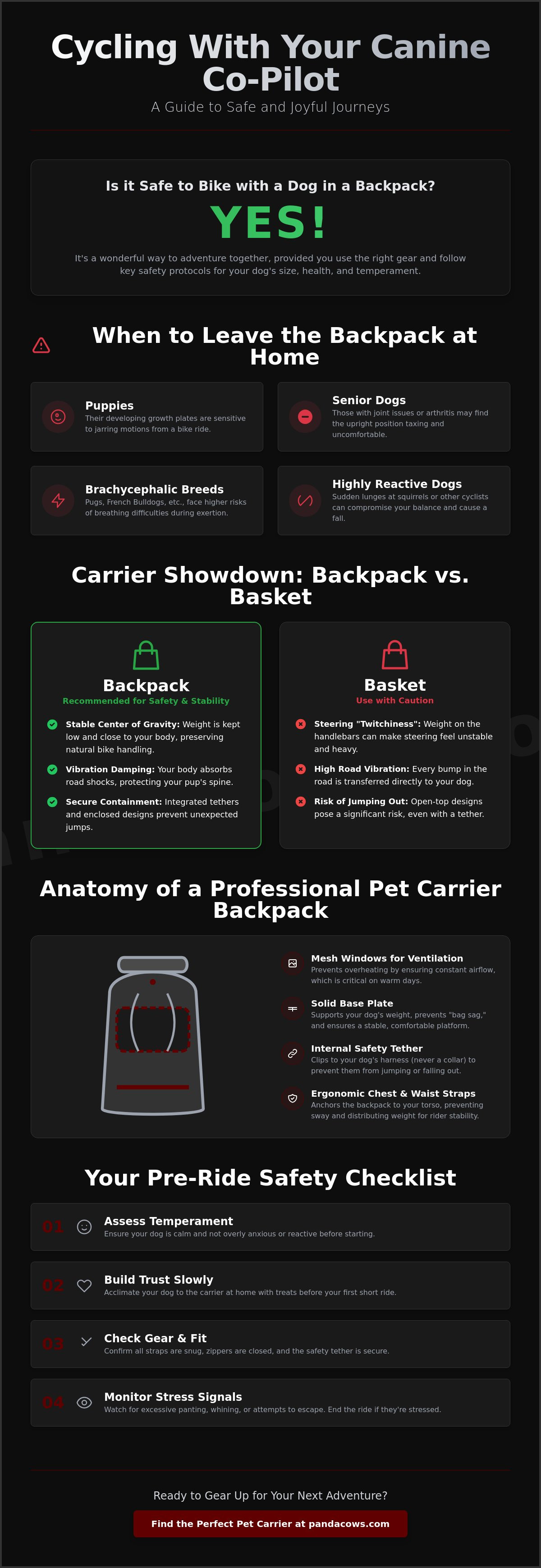
There are times when the most loving choice is to leave the backpack at home. Puppies with developing growth plates should avoid the jarring motions of a bike ride, as their skeletal systems are still finding their footing. Similarly, senior dogs with joint issues or arthritis might find the upright position of a carrier quite taxing. Brachycephalic breeds, like Pugs or French Bulldogs, face higher risks of breathing difficulties during outdoor exertion or at varying altitudes. Finally, if your dog is extremely reactive to squirrels or other cyclists, the risk of a sudden lunge makes the backpack a "no-go" for everyone's safety.
Understanding the Risks of the 'Rucksack' Approach
Choosing the wrong gear can turn a joyful jaunt into a risky endeavor. One major risk is the "whiskey throttle" effect, where a dog shifts their weight abruptly during a turn, causing you to over-correct and lose control. Heat exhaustion is another concern, particularly in poorly ventilated carriers that lack mesh windows. Perhaps the biggest danger is using a standard human rucksack. These bags aren't designed for canine anatomy, often lacking the structural floor and safety tethers found in a dedicated Pet Carrier Backpack. Without these features, your dog could slip out or suffer from poor circulation during the ride.
The Science of Safety: Weight Distribution and Canine Comfort
When considering is it safe to bike with a dog in a backpack, one must account for the invisible forces of physics that govern every turn and stop. Your bicycle operates on a delicate balance of lean angles and center of gravity. When you add a furry passenger, that center of gravity shifts upward and backward, which can significantly alter how your bike responds to your steering inputs. Keeping your dog in a "low-sit" position against your mid-back is the most effective way to minimize this impact. This placement ensures the weight remains close to your own center of mass, allowing for a more predictable ride.
Stability for the rider is just as vital as comfort for the canine. Chest straps and waist belts are non-negotiable features for any serious cycling setup. These straps act as an anchor, preventing the bag from swaying independently of your body. Without them, a sudden shift from your dog could create a centrifugal force that pulls you off balance. A well-fitted Pet Carrier Backpack utilizes these ergonomic supports to marry the carrier to your torso, ensuring that you and your co-pilot move as one cohesive unit.
The Physics of the Pivot
Standing up to pedal might be your go-to move for steep hills, but it's a risky maneuver with a dog on your back. This side-to-side swaying creates a "pendulum effect" that can quickly become difficult to manage, especially during sudden braking. You must remain seated to keep the weight stable and avoid tossing your pup around. A 20lb dog feels like 30lbs of centrifugal force pulling you outward during a high-speed turn. By maintaining a steady, seated position, you can navigate corners without the weight of your passenger causing the bike to "wash out" from under you.
Canine Ergonomics in the Air
The internal environment of the carrier determines how long your dog will enjoy the ride. A solid base plate is essential to prevent "bag sag," which can lead to leg numbness or an uncomfortable crouching position. You should ensure your dog's spine remains in a natural, neutral curve rather than being forced into a tight ball. Following ASPCA travel safety tips, always prioritize proper ventilation and hydration, particularly during long climbs where heat can build up quickly. Internal safety tethers are a must-have, but they should only ever be attached to a harness. Attaching a tether to a collar puts your dog at risk of severe neck injury if you have to stop abruptly or if the bag shifts unexpectedly.
Backpacks vs. Baskets: Choosing Your Pup’s Commute Style
Every cyclist has a preferred rhythm, and choosing how your dog joins that flow is a vital part of your shared journey. Many pet parents wonder is it safe to bike with a dog in a backpack compared to using a traditional front-mounted basket. The answer often lies in how you handle the road. Backpacks offer superior shock absorption because your body acts as a natural suspension system, cushioning your companion from the jolts of uneven pavement. While baskets provide a lower center of gravity, they can make your steering feel "twitchy" and unpredictable, especially if your pup decides to lean toward a passing butterfly.
For those with larger companions, cargo bikes stand out as a robust safety choice, though their high entry cost and bulky size aren't for everyone. Trailers are another popular alternative, serving as the best option for long-distance touring. However, trailers make it much harder to monitor your dog's vitals or emotional state in real-time. Adhering to AVMA travel guidelines ensures that whichever method you choose, you are prioritizing the physiological and safety needs of your animal friend.
Why Active Riders Prefer Backpacks
Active riders often gravitate toward backpacks because they foster a deep sense of connection and "human-anchor" trust. By wearing your dog, you can feel their breathing and subtle movements, allowing for instant communication without taking your eyes off the trail. This setup is also incredibly versatile. You can easily transition from a morning bike ride to a mid-day hike without the need to switch gear or carry extra equipment. If your lifestyle includes hopping from a bike trail to a terminal, you might find our Ultimate Guide to Airline Approved Dog Carriers helpful for mastering multi-modal travel with your "fur-st" mate.
The Safety Limitations of Baskets
While baskets look charming, they come with specific safety limitations that every rider should consider. The "ejection risk" is much higher in open-top baskets, requiring extra-secure tethering that can sometimes interfere with a dog's ability to sit comfortably. Weight limits on handlebars are often quite low, and exceeding them can make your bike's front end feel heavy and sluggish. Weather protection is another factor; backpacks leverage your body heat to keep dogs warmer, whereas baskets expose them directly to wind chill and road spray. When asking is it safe to bike with a dog in a backpack, the added protection from the elements often makes the backpack the "paws-down" winner for year-round adventurers.
Your Pre-Ride Safety Checklist and Training Protocol
Preparation is the secret ingredient that transforms a nervous outing into a smooth, tail-wagging excursion. While you now know that it's physically possible, the question of is it safe to bike with a dog in a backpack truly depends on your training timeline. You can't simply load your pup and sprint into traffic; you must build a foundation of "human-anchor" trust. This progressive protocol ensures your dog feels secure while you master the unique handling of a loaded bicycle.
- Step 1: Floor-Level Desensitization. Place the open carrier on the floor and let your dog explore it at their own pace. Use high-value treats and positive reinforcement to create a "paws-itive" association with the bag.
- Step 2: The Living Room Commute. Once they are comfortable inside, wear the backpack around the house while doing light chores. This helps your dog get used to your natural walking rhythm and the height of your shoulders.
- Step 3: Static Bike Mounting. Stand next to your bike while wearing your loaded co-pilot. Practice getting on and off the saddle without moving to ensure you can manage the weight shift safely.
- Step 4: The 'Quiet Street' Trial. Find a flat, deserted stretch of pavement for your first ride. Keep your speed low and avoid distractions to let your dog acclimate to the wind and the hum of the tires.
- Step 5: Gradual Expansion. Slowly introduce busier streets, different road textures, and gentle inclines. Each successful ride builds the confidence needed for longer adventures.
Essential Gear for the Safe Biking Duo
Safety is a team sport, and having the right equipment makes all the difference. Inside the pack, your dog should wear a reflective dog harness to ensure they stay centered and visible if you need to open the bag for a quick check. Eye protection, often called Doggles, is another necessity to prevent wind-borne debris or low-hanging branches from causing injuries. Don't forget to pack a portable pet water bottle for frequent hydration breaks, as the wind and sun can dehydrate a small dog faster than you might expect. For the ultimate peace of mind, explore our full collection of durable Pet Carrier Backpack options designed for active lifestyles.
Post-Ride Vitals and Comfort Check
The adventure doesn't end when you click the kickstand. Once you're home, perform a thorough "vitals check" to ensure your dog is recovering well. Inspect their paw pads for any "carrier rub" or irritation that might have occurred from the base plate during bumpy sections. Watch for signs of motion sickness, such as excessive drooling, or delayed heat stress if the weather was particularly warm. You can use a calming pet blanket to help your dog decompress and lower their heart rate after the high-energy adrenaline of a ride.
Gearing Up for Joyful Journeys with Panda Cows
Choosing to include your pet in your cycling routine is a beautiful way to deepen your connection, but it requires equipment that matches your ambition. We understand that when you ask is it safe to bike with a dog in a backpack, you aren't just looking for a bag; you're looking for a promise of security for your best friend. At Panda Cows, we've dedicated ourselves to being more than just a store. We are your supportive partner in every "paws-itive" adventure, offering a curated selection of travel gear that transforms a simple bike ride into a series of meaningful interactions.
Our "Bond-First" philosophy means we treat every product as a tool for emotional fulfillment. We don't just sell carriers; we provide the means for you to share the wind in your hair and the sun on your faces. Whether you are navigating busy city streets or exploring quiet, winding forest paths, our goal is to provide tranquility for the owner and vitality for the pet. We invite you to join our growing community of "Adventure Cows." These are the dedicated explorers who refuse to leave their companions behind, choosing instead to embrace the open road together with confidence and joy. It is a celebratory lifestyle that focuses on the abstract ties that make pet ownership so rewarding.
The Panda Cows Quality Promise
We take the responsibility of your pet's safety seriously, which is why our Pet Carrier Backpack undergoes rigorous testing for durability and excellence. We focus on reinforced, weight-bearing seams that won't fail during a steep climb and breathable mesh panels that ensure your dog stays cool and comfortable. These ergonomic designs protect your back by distributing weight evenly while maintaining your pet's natural posture. Our customer support team understands the subtle nuances of pet travel, providing a knowledgeable and lighthearted guide for every step of your journey. We anchor our descriptions in high-standard quality markers so you can feel both delighted by our personality and secure in your purchase.
Ready for Your First Ride?
The world is waiting for you and your co-pilot to discover its hidden gems together. Browse our travel collection today to find a Pet Carrier Backpack that fits your style and your dog's needs. You can also sign up for our "Adventure Guides" to receive the latest safety tips and gear recommendations directly in your inbox. There is a unique sense of peace that comes from a shared outdoor experience, and we are here to ensure you feel both delighted by the journey and confident in the quality of your gear. Take the leap, grab your helmet, and start your next "fur-st" class adventure today. Your journey toward a high quality of life for your pet starts with a single pedal stroke.
Ready to Roll Toward New Horizons?
You’ve explored the physics of the pivot and the importance of maintaining a low-sit position for ultimate stability on two wheels. You now understand that selecting a backpack over a basket provides superior shock absorption for your pup's comfort while fostering a deeper emotional link through every turn. By now, you've discovered that is it safe to bike with a dog in a backpack as long as you prioritize ergonomic support and follow a patient, progressive training plan that builds "human-anchor" trust.
It’s time to turn those backyard practices into breathtaking vistas and shared memories. Explore our Safety-First Pet Carrier Backpacks and start your adventure today! We are proud to have supported over 10,000 happy adventure-seeking pets with our expert-curated travel gear, ensuring every outing is as secure as it is joyful. To make your next journey even smoother, we provide free shipping on all US orders so you can focus on the path ahead. The sun is shining, the trails are open, and your "fur-st" mate is ready for the ride of a lifetime. Happy cycling!
Frequently Asked Questions
How long can a dog safely stay in a backpack while biking?
A dog should typically spend no more than 45 to 60 minutes in a carrier before taking a "paws-itive" stretch break. These intervals allow your pup to hydrate and relieve themselves while preventing muscle stiffness from sitting in a static position. If you're on a longer trek, plan for frequent stops to check their temperature and ensure they remain enthusiastic about the journey.
What is the maximum weight for a dog bike backpack?
Most purpose-built carriers are rated for dogs up to 25 or 30 pounds to maintain proper bicycle balance. While some heavy-duty models might support more, adding too much weight high on your back can make your steering feel "ruff" and unpredictable. Always check the specific weight capacity of your Pet Carrier Backpack to ensure a secure fit for your furry co-pilot.
Can biking with a dog in a backpack cause back pain for the owner?
Back pain is a distinct possibility if you use a pack without proper ergonomic support or weight distribution features. You can avoid "aching-tail" syndrome by choosing a carrier with padded shoulder straps, a chest clip, and a sturdy waist belt. These features transfer the load to your hips, which keeps your spine happy and your ride revitalizing.
Do dogs actually enjoy being in a backpack while cycling?
Many dogs find the elevated view and the wind in their fur quite "fur-filling" once they are properly acclimated to the motion. Success depends on your dog's unique personality and your dedication to a patient training protocol. When you ask is it safe to bike with a dog in a backpack, remember that a dog's calm enjoyment is the best indicator of a secure and joyful adventure.
Is it legal to bike with a dog in a backpack in the USA?
It is generally legal across the United States as long as your pet is securely contained and doesn't interfere with your ability to control the bicycle. Local ordinances can vary, so it's a smart idea to check your specific city's cycling laws before heading out. The primary legal focus is usually on preventing the dog from being a distraction or a physical hazard to other road users.
What should I do if my dog starts panicking while I'm riding?
Stop your bicycle immediately in a safe area and calmly reassure your pet before attempting to unload them. Sudden movements or whining are clear signs that your dog has reached their emotional limit for the day. You should never force a stressed animal to continue, as this can break the "human-anchor" trust you've worked so hard to build during your training sessions.
How do I keep my dog cool inside a backpack on hot days?
Prioritize carriers with high-airflow mesh panels and use a Portable Pet Water Bottle to offer frequent drinks during your journey. You can also place a small, fabric-covered ice pack at the base of the bag to provide a chilled environment for your passenger. Avoid riding during the peak heat of the afternoon to protect your companion from potential heat stress and dehydration.
Does my dog need to wear a helmet while in the backpack?
Dogs don't strictly need helmets while tucked inside a backpack, but they do benefit from other specialized safety gear. A Reflective Dog Harness is much more effective for keeping them centered and secure while you are in motion. You might also consider dog goggles to protect their eyes from dust and wind-borne debris while you're cruising at higher speeds through the park.