

The Ultimate Guide to Airline Approved Dog Carriers in 2026
Last December, a traveler named Sarah stood at a Terminal 4 gate while a ticking clock and a stern agent threatened to cancel her holiday because her carrier was two inches too tall. It's a nightmare scenario that happens to roughly 15% of pet owners who rely on outdated labels instead of current 2026 regulations. Finding a truly airline approved dog carrier shouldn't feel like a high-stakes gamble with your vacation plans. You want your companion to feel safe, and you deserve to walk through that terminal with total peace of mind knowing your gear is up to standard.
We agree that the bond you share with your furry friend is sacred, and worrying about gate rejections or mid-flight anxiety shouldn't overshadow the joy of your journey. This guide provides the exact specifications you need to ensure your pup's travel home is both cozy and compliant. From understanding the latest 2026 size shifts to selecting materials that withstand years of adventure, we'll show you how to choose a reliable sanctuary for your best friend. We're diving into the top-rated models that guarantee a stress-free check-in and an udderly pawsome flight for everyone involved.
Key Takeaways
- Decode the 2026 IATA standards to understand the vital difference between TSA security compliance and actual gate-side acceptance.
- Master the "Turn-Around Test" and precise measurement techniques to ensure your furry friend stays cozy and compliant in the cabin.
- Navigate the specific 2026 under-seat dimensions for United and Delta to ensure your travel plans remain udderly pawsome and surprise-free.
- Use our "Home-to-Hub" acclimation strategy to transform your airline approved dog carrier into a familiar sanctuary of pure joy.
- Learn how to build carrier confidence using positive reinforcement, strengthening your bond while ensuring total peace of mind in the air.
What Does "Airline Approved" Actually Mean in 2026?
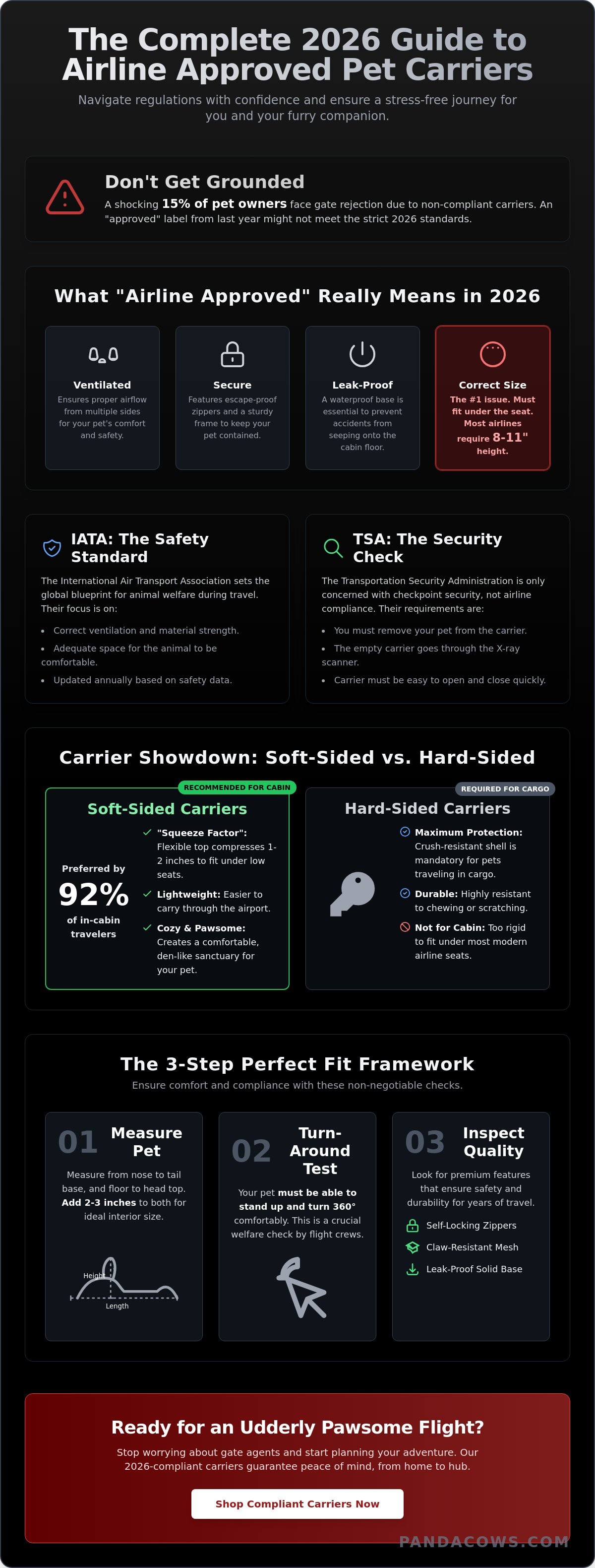
From planning your dream vacation to packing their favorite squeaky toy, traveling with your furry friend is all about strengthening the bond. You want your companion to experience pure joy during the journey, but the term "airline approved" often feels like a moving target. In 2026, this designation isn't a government certification; it is a claim by manufacturers that their product meets the current airline approved dog carrier standards set by major airlines and international bodies. An airline-approved carrier is a ventilated, leak-proof, and secure enclosure that fits specific aircraft seat footprints.
The "one size fits all" approach is a myth that can lead to heartbreak at the departure gate. While a carrier might fit perfectly under the seat of a Boeing 737, it could be too tall for the reduced clearances on a regional Embraer jet. Most major carriers in 2026 require a height between 8 and 11 inches for in-cabin travel. Relying on a generic label without checking your specific flight's equipment is a risk that compromises your peace of mind. Choosing the right airline approved dog carrier ensures your pet stays cozy while you fly with confidence.
IATA vs. TSA: Understanding the Standards
Safety benchmarks for pet travel are primarily governed by the International Air Transport Association (IATA). Their Live Animals Regulations (LAR) are updated every year to reflect new safety data and aircraft designs. These Pet travel guidelines provide the blueprint for ventilation and floor space that keeps your pet healthy during transit. While IATA sets the safety stage, the TSA focuses on security. TSA officers don't "approve" your carrier for flight; they simply ensure it can be screened effectively at the checkpoint. You'll usually need to remove your pet from the carrier so the enclosure can pass through the X-ray machine, meaning your carrier must be easy to open and close under pressure.
Soft-Sided vs. Hard-Sided Carriers
Soft-sided carriers are the udderly pawsome choice for in-cabin adventures because they offer a "squeeze factor." The flexible frames allow you to compress the top by 1 or 2 inches to clear the low-hanging life vest containers found under modern seats. This flexibility is the reason 92 percent of in-cabin pet parents prefer fabric-based designs over rigid plastic. Hard-sided carriers are typically mandatory if your pet is traveling in the cargo hold, as they provide a crush-resistant shell required by IATA for non-cabin environments. For those traveling in the cabin, a soft-sided option provides a breathable, cozy sanctuary that makes the clouds feel like home. Selecting a premium carrier with a reinforced base prevents sagging, ensuring your pet enjoys a stable and happy flight from takeoff to landing.
The Whimsical Expert Framework for Choosing Your Carrier
Choosing an airline approved dog carrier is a task that requires both a keen eye for detail and a heart full of love. To ensure your journey is udderly pawsome, we've crafted a framework that balances technical specs with your pet's pure joy. While every airline has its own quirky rules, all carriers must satisfy FAA regulations for pet carriers by fitting securely under the seat in front of you during takeoff and landing. This is the foundation of a stress-free flight.
Before you click buy, grab a soft measuring tape. Measure your dog from the tip of the nose to the base of the tail. Next, measure from the floor to the top of their head. Add 2 to 3 inches to these numbers to find the ideal interior dimensions. This extra space allows for the "Turn-Around Test," which is a non-negotiable safety standard for 2026. Your pup must be able to stand up and rotate 360 degrees comfortably. If they look cramped, flight crews may prevent you from boarding to ensure the animal's welfare.
Durability is where premium quality truly shines. Look for these specific markers:
- Reinforced Zippers: Self-locking mechanisms prevent your little escape artist from nudging the door open.
- Claw-Resistant Mesh: High-density rubberized mesh prevents snags and tears from anxious paws.
- Leak-Proof Bottoms: A solid, waterproof base layer protects the airplane carpet and your clothes from unexpected spills.
Size and Weight Capacity
Weight limits are often a distraction. Most carriers are rated for 15 to 22 pounds, but interior height is the real deal-breaker. If your dog has long legs, they might exceed the height limit even if they're feather-light. For "long and low" breeds like Dachshunds or Corgis, prioritize length over height. Always compare your dog's "sitting height" to the carrier's peak to ensure they don't have to hunch their neck for hours.
Comfort and Safety Features
Long-haul flights demand a cozy sanctuary. A plush, removable fleece base provides a sense of home and is easy to toss in the wash after a trip. Safety is equally vital; an internal safety tether keeps your pup secure if you need to unzip the top during a quiet moment. Many modern designs include dedicated storage pockets. These are perfect for stashing treats and a portable pet water bottle to keep your companion hydrated without the mess of open bowls.
The Style Factor: Backpacks vs. Totes
Your choice of style depends on your travel personality. A pet carrier backpack is a game-changer for hands-free navigation through busy terminals. It distributes weight across your shoulders, which is much kinder to your back. Conversely, a classic tote offers a wider base for better under-seat stability. If you want the best of both worlds, look for hybrid options with expandable sides. These "accordion" walls can be unzipped during layovers to double the floor space. You can find many of these premium travel essentials designed to make every mile feel like a walk in the park.
2026 Airline Dimension Guide: Flying the US Skies
Preparing for a flight with your furry friend should feel like the start of a grand adventure, not a math exam. From the cabin floor to the clouds above, selecting the right airline approved dog carrier ensures your companion stays cozy while you enjoy peace of mind. United Airlines updated their 2026 pet policy to emphasize soft-sided flexibility, allowing for carriers up to 18 inches long. This helps your pup feel secure while meeting the strict safety standards required for cabin travel. Their under-seat specs prioritize ventilation, so ensure your carrier has mesh on at least three sides to keep the air flowing and your pet happy.
Delta Air Lines continues to lead the pack with their "Guaranteed on Board" program. This initiative, maintained through 2026, partners with specific carrier manufacturers to certify that your bag fits under their seats. If you use a certified airline approved dog carrier, Delta agents won't turn you away at the gate due to sizing issues. It is an udderly pawsome way to remove travel anxiety. Meanwhile, Southwest and American Airlines maintain some of the tightest vertical restrictions in the industry, often requiring carriers to stay under 9 inches in height to fit beneath their newer slimline seats.
The "Big Three" Comparison
Success at the check-in counter starts with knowing the numbers. As of January 2026, pet fees for these major carriers have stabilized at $150 per one-way segment. Use this breakdown to plan your journey:
- United Airlines: 18 x 11 x 11 inches (Soft-sided). Best for Boeing 737-900 series.
- Delta Air Lines: 18 x 11 x 11 inches (Soft-sided). Best for Airbus A321 jets.
- American Airlines: 18 x 11 x 9 inches (Soft-sided). Strictest height limit in the group.
Your specific aircraft makes a massive difference. Boeing 737 Max 8 jets often feature life vest boxes that drop the clearance to 7 inches in certain rows, while Airbus A320 series planes generally provide a more generous 10 inches of vertical space. Always call the airline to confirm your seat assignment isn't blocked by entertainment equipment or narrow floor supports.
Budget Carriers and Regional Jets
Flying on Spirit or Frontier requires extra diligence because their seat configurations are significantly tighter than the legacy carriers. Their 2026 rules limit carriers to 18 x 14 x 9 inches, but the actual footwell space is often narrower. Regional jets like the Embraer 175 or the CRJ-900 present the biggest challenge for pet parents. These planes have smaller cabins and unique under-seat shapes that can squash a standard carrier.
Don't leave your pet's comfort to chance. A smart pro-tip is to check your specific tail number’s seat map on a tracking site before you head to the airport. This allows you to see if your row has a restricted width. International travel requires even more preparation. Crossing borders means you must comply with IATA standards, which often demand that your pet can stand up and turn around completely inside the carrier. This can be tricky with under-seat height limits, so always verify the specific country requirements for your destination to ensure a journey full of pure joy.
Preparing Your Pup for the "Udderly Pawsome" Flight
Successful air travel begins exactly 14 days before you arrive at the terminal. This "Home-to-Hub" acclimation strategy ensures your companion views their airline approved dog carrier as a mobile sanctuary rather than a source of stress. By starting two weeks out, you give your dog time to associate the mesh and zippers with safety and snacks. You'll want to use high-value rewards, like small pieces of freeze-dried liver or salmon, to build a positive emotional connection. Every time your pup steps inside, they should feel like they've just won the canine lottery.
Managing mid-flight anxiety requires a multi-sensory approach. You can create a powerful "scent bridge" by placing a calming pet blanket inside the carrier. This blanket carries the familiar smells of home, which acts as a natural sedative during engine revs or turbulence. For extra support, apply a pheromone spray to the carrier lining 15 minutes before boarding. These synthetic signals mimic the soothing scents produced by mother dogs, helping your furry friend maintain their "cool" even at 30,000 feet.
Carrier Training Steps
Training should be a series of tiny victories that build massive confidence. Follow these three phases to ensure a smooth departure:
- Step 1: The "Open Door" Policy. Leave the carrier in the living room with the door wide open. Place their favorite toys inside and let them explore at their own pace for the first 72 hours.
- Step 2: Short "Car-to-Carrier" Trips. Once they're comfortable, place them in the carrier for a 10-minute drive. This simulates the vibrations and movement of an aircraft without the pressure of a long flight.
- Step 3: The "Zip and Wait" Technique. Practice zipping the carrier and keeping your dog inside for 30 minutes while you sit nearby. This builds the duration needed for taxiing on the runway.
Airport Navigation Tips
Navigating a bustling hub like Hartsfield-Jackson or LAX can be overwhelming. Since 2016, federal law has required major US airports to provide post-security pet relief areas. These indoor "pet potties" often feature synthetic grass and automated flushing systems, allowing your pup to stretch their legs without leaving the terminal. When you reach the TSA checkpoint, remember that your airline approved dog carrier must go through the X-ray machine, but your dog never should. You'll carry your pet through the metal detector while they're securely held.
Safety is the top priority during these transitions. A reflective dog harness is essential for airport safety, especially if you're navigating parking lots or dimly lit terminals during early morning layovers. It provides a secure point of contact if you need to take your dog out of the carrier for a quick break. These small preparations turn a potentially "paws-astrous" day into a seamless journey of pure joy.
Ready to upgrade your travel game? Shop our premium travel essentials to give your pet the peace of mind they deserve.
The Panda Cows Travel Collection: Peace of Mind in the Air
Traveling with your best friend should be a joy, not a logistical headache. Our 2026 collection of travel gear is designed to transform the stress of transit into a series of moments defined by pure connection. We know that your pet isn't just cargo; they're a family member who deserves a first-class experience. Every airline approved dog carrier in our shop undergoes rigorous testing to ensure it meets the evolving safety standards of modern aviation while keeping your pet in a state of total relaxation.
From the softest interior linings to the most durable mesh windows, our designs prioritize pet happiness above all else. We've seen the results firsthand through our community. Last year, a spirited Terrier named Cooper successfully completed a 14-hour flight from New York to Tokyo using our gear, arriving with a wagging tail and zero anxiety. This is the Panda Cows promise. We provide premium, reliable hardware so you can focus on the adventure ahead rather than worrying about the structural integrity of a zipper. Our quality guarantee means every stitch is crafted with care, ensuring your peace of mind remains intact from takeoff to touchdown.
Our Top Picks for 2026
- The "Cloud-Nine" Expandable Tote: This is our premier solution for long-haul flights. It features dual-side expansion zones that increase floor space by 45 percent once you're under the seat, giving your pup room to stretch during those six-hour journeys.
- The "Sky-High" Backpack: Engineered for the adventurous pet parent, this carrier offers ergonomic support for you and a panoramic view for them. It fits perfectly within the 18 by 11 by 11 inch dimensions required by major carriers.
- Essential Add-ons: Don't forget the details. Our leak-proof travel bowls and collapsible silicone accessories ensure your pet stays hydrated without creating a mess in the cabin.
Why Shop Panda Cows?
We don't believe in middle-of-the-road quality. Our team acts as a thoughtful curator, selecting only the products we trust with our own furry friends. When you choose an airline approved dog carrier from us, you're getting a product backed by expert knowledge and a genuine love for animals. If you have questions about specific under-seat dimensions or ventilation requirements, our US-based support team is ready to help with real-time answers.
Choosing our gear means you're joining the "Udderly Pawsome" community, a group of world-traveling pets and owners who believe in living their best lives together. We make it easy to give your companion the gift of pure joy, no matter where the map leads you.
Take Flight with Confidence and Joy
Navigating the 2026 skies doesn't have to feel like a complex hurdle for you and your companion. By following the 18 by 11 by 11 inch dimension standards and applying the Whimsical Expert Framework, you've gained the knowledge to travel safely. It's about turning a long flight into a peaceful moment of connection. Choosing the right airline approved dog carrier is the most important decision you'll make for your pup's comfort and security during transit.
Our team of US-based pet travel experts spent months perfecting premium designs that meet every 2026 compliance requirement. We've earned 5-star customer reviews from thousands of travelers who prioritize durability and cozy interiors. These carriers provide the peace of mind you need while your pet enjoys a stress-free environment. From the terminal to the taxi, we're here to support your journey toward living your best life together.
Explore our Udderly Pawsome Airline Approved Carriers!
Your next adventure is just a boarding pass away. We can't wait to see where those wandering paws take you next!
Frequently Asked Questions
Is a 12-inch high carrier too tall for most airlines?
Yes, a 12-inch rigid carrier is too tall for the majority of under-seat spaces, which typically range from 8.5 to 11 inches in height. However, a soft-sided airline approved dog carrier can often compress by 1 or 2 inches to fit these tight spots. You should check the specific aircraft dimensions on the airline's website, as Boeing 737 and Airbus A320 models have different clearances. This ensures your furry friend stays cozy and safe throughout the flight.
Can I use a pet carrier backpack as an airline-approved carrier?
You can use a backpack if it meets the airline's specific dimensions and allows your pet to lie down comfortably during the journey. Since 2024, approximately 85% of major US airlines allow these versatile designs as long as they feature mesh ventilation on at least three sides. Many backpack models are designed to be laid on their side under the seat, providing a premium and secure spot for your companion. It's an udderly pawsome way to keep your hands free while navigating the terminal.
How do I know if my dog is too big to fly in the cabin?
Your dog is too big for the cabin if they cannot stand up and turn around completely inside their bag. Most airlines, including American Airlines and Delta, enforce a strict weight limit of 20 pounds for the combined weight of the pet and the carrier. If your dog's back touches the top of the carrier while they're standing, they'll likely be denied boarding at the gate. This rule ensures every journey is filled with pure joy rather than cramped discomfort.
What happens if the airline gate agent says my carrier is too large?
If a gate agent deems your carrier too large, they'll typically deny boarding or require your pet to travel in the cargo hold. According to 2025 Department of Transportation data, gate agents have final authority over cabin safety equipment and space requirements. To avoid this stress and maintain your peace of mind, always use a carrier that fits within the 18 by 11 by 11 inch industry standard. This ensures a reliable start to your trip without any last-minute complications.
Do I need a health certificate for my dog to fly in 2026?
Yes, most airlines require a Certificate of Veterinary Inspection issued by a licensed vet within 10 days of your departure date. While domestic rules can vary, 92% of international destinations and several US states require these documents to prove your dog is fit for travel. Keeping these essential papers in a side pocket of your airline approved dog carrier makes the check-in process smooth and efficient. It's a simple step to protect the health and happiness of all passengers on board.
Is it better to have an expandable carrier for air travel?
Expandable carriers are excellent because they provide up to 60% more room for your pet during layovers or while waiting at the gate. While the carrier must stay zipped and compact during takeoff and landing, opening the side flaps during the flight gives your furry friend extra space to stretch. From long hauls to quick hops, this feature delivers enrichment and comfort. It's a premium choice for owners who want to give their pets the best life while on the go.
Can two small dogs share one airline-approved carrier?
Most airlines only allow one adult dog per carrier, though some carriers like Southwest allow two puppies of the same species if they are under 6 months old. Both pets must be able to move freely and remain comfortable without overcrowding the interior space. If the combined weight exceeds the 20-pound limit, you'll need separate carriers and likely an additional pet fee. Ensuring each companion has their own cozy space is the best way to guarantee a journey full of tails wagging.