

Escape Proof Cat Carrier for Car Travel: The Ultimate Safety Guide for 2026
Last Tuesday, Sarah discovered that her clever tabby, Oliver, had a hidden talent for locksmithing when he popped his carrier zipper right on the interstate. It is a heart-stopping moment every pet parent dreads, yet it happens all too often when a tiny escape artist outsmarts a flimsy latch. Finding a truly escape proof cat carrier for car travel is not just about convenience; it is about ensuring your adventurous feline stays safely tucked away while you focus on steering toward your next adventure.
We know you want to provide the most secure journey for your whiskered companion, but it is hard to feel tranquil when zippers slide open under pressure or mesh rips at the first sign of a claw. You deserve to travel with complete confidence, knowing your pet is protected by a sturdy triad of anti-slide zippers, seatbelt-ready frames, and claw-proof ventilation. Discover how to secure your favorite furry traveler with the most durable, road-ready carriers available in 2026.
We will explore the latest safety standards, compare top-rated crash-tested models from brands like Diggs and Sleepypod, and reveal how to choose a carrier that turns a stressful car ride into a paws-itively peaceful experience for everyone involved.
Key Takeaways
- Understand the "paws-ability" of disaster and why a strategic travel plan is your first line of defense against feline road panic.
- Spot the must-have hardware, like locking zippers and claw-proof mesh, that defines a high-quality escape proof cat carrier for car travel.
- Weigh the benefits of armored hard shells against luxury soft-sided options to ensure your pet’s journey is as smooth as a catnap.
- Master the Back Seat Rule and learn how to integrate your carrier with your car’s seatbelt system for maximum security during sudden stops.
- Explore how vault-style security features in pet carrier backpacks can transform stressful commutes into celebratory bonding moments for you and your feline friend.
Why Every Feline Escape Artist Needs a Strategic Travel Plan
Every feline owner knows that a car trip can quickly turn from a peaceful commute into a whiskers-clenching drama. While we dream of sun-drenched road trips, the reality for many cats is a whirlwind of scary vibrations and loud engine hums. This sensory overload triggers a primitive panic response, which often leads to a desperate search for an exit. Without a strategic plan and a reliable escape proof cat carrier for car travel, your curious companion might decide that the space under your brake pedal is the safest place to hide. By understanding the "paws-ability" of risk, you can transform a chaotic car ride into a serene journey toward quality time together.
Standard carriers often fail because they are designed for simple transport rather than high-stakes security. When you are researching different types of pet carriers, it becomes clear that basic nylon mesh and plastic latches are no match for a cat in survival mode. A determined feline can exert surprising force through head-butting or persistent clawing at weak seams. By shifting your perspective from seeing a carrier as a simple box to viewing it as a mobile sanctuary, you prioritize your cat's holistic well-being and your own peace of mind. A sanctuary provides a familiar, tranquil environment that buffers the noise of the road while keeping those clever paws exactly where they belong.
The Danger of the 'Great Escape' on the Road
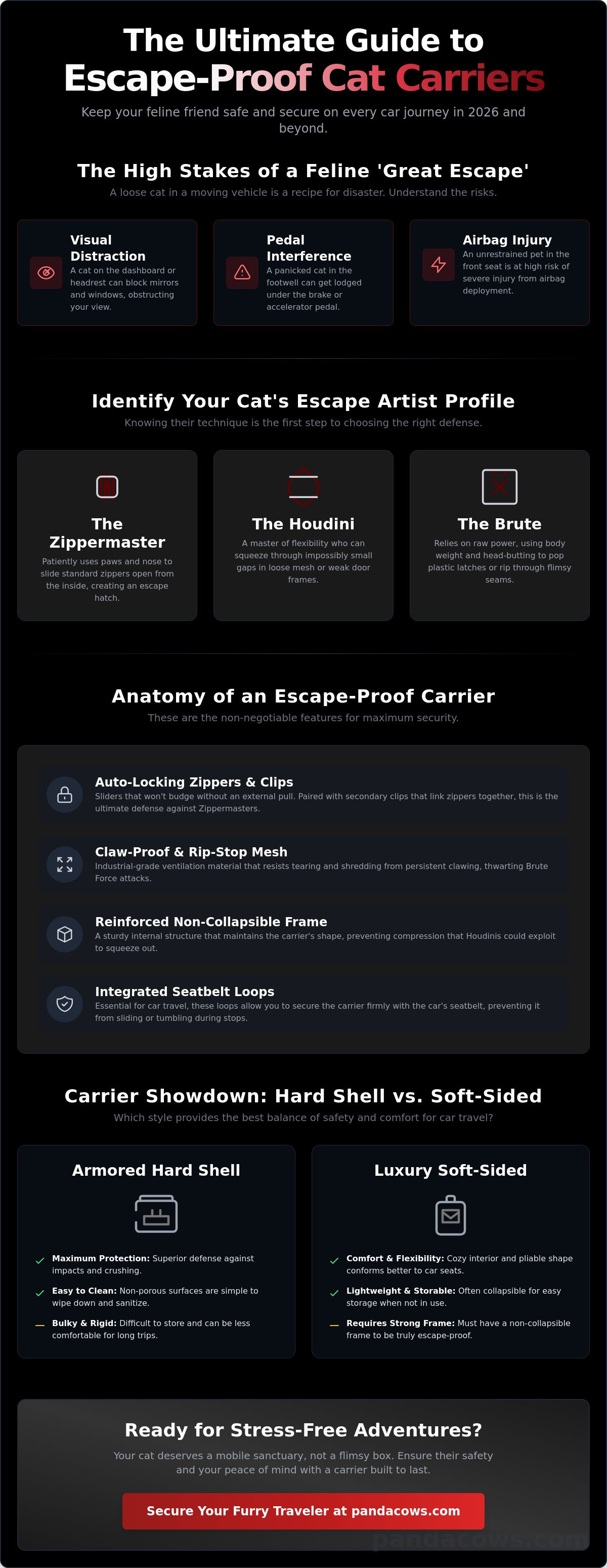
A loose cat in a moving vehicle creates a cascade of hazards that put everyone at risk. Visual distractions are the most immediate threat, as a cat leaping onto the dashboard or climbing the headrests can block your mirrors and windows. The most terrifying scenario involves pedal interference; a panicked cat often dives into the footwell, potentially wedging themselves under the brake or accelerator. Additionally, unrestrained pets in the front seat face severe injury from airbag deployment during sudden stops. Keeping your kitty secured is the only way to ensure the car remains a safe space for all passengers.
Identifying Your Cat's Escape Style
Every feline has a unique approach to breaking free, and recognizing these patterns helps you choose the right defense. The "Zippermaster" is the technician who uses their paws to patiently slide zippers apart from the inside. The "Houdini" is a master of flexibility, capable of squeezing through seemingly impossible gaps in mesh or loose door frames. Finally, the "Brute" relies on raw power, using their body weight to pop plastic latches or rip through standard fabric. By identifying these specific behaviors, you can invest in a carrier with the specific locking mechanisms and reinforced materials needed to outsmart your little adventurer.
The Anatomy of an Escape-Proof Cat Carrier: Features That Actually Work
While many owners focus on the size of the bag, the real magic of an escape proof cat carrier for car travel lies in the tiny details that outsmart your clever companion. Smart felines don't just wait for a door to be left open; they actively troubleshoot the hardware. If your current bag relies on standard zippers, your cat might already be practicing the zipper-slide technique. This is where a kitty uses their paws to create a small gap and then nudges their head through to force the teeth apart. To prevent this, look for auto-locking sliders that stay in place unless the external pull tab is moved. Anti-escape clips are a mandatory feature for 2026 to ensure that even the most persistent paws stay safely inside. Pairing these with lobster claw clips that link two zippers together provides a secondary layer of defense that no amount of poking can bypass.
When looking at top-rated cat carriers, you'll notice a shift toward industrial-grade materials. Structural integrity is vital because a flimsy bag can be compressed, allowing a cat to use leverage to squeeze out of small openings. A non-collapsible frame maintains the bag's shape during the vibrations of a car ride, which helps your pet feel secure rather than trapped. For those who prefer a more adventurous style, a Pet Carrier Backpack often features these rigid frames alongside multiple entry points, giving you the flexibility to load your kitty from the top or side while using secondary latching mechanisms for total security.
Locking Zippers vs. Standard Zippers
Standard zippers are designed for luggage, not for active, clawed escape artists. Auto-locking sliders utilize an internal spring mechanism that prevents the zipper from moving due to internal pressure. This means that even if your cat leans their full weight against the door, the zipper remains locked. Lobster claw clips act as a physical padlock for your bag, ensuring that the two zipper heads cannot be pulled apart by curious paws.
Mesh Durability: Rubberized vs. Fabric
Mesh durability is where many standard carriers fall short. Fabric mesh is easily shredded by a determined Houdini who wants to see what's happening under the passenger seat. Rubberized or vinyl-coated screens are much more resilient because they resist the snag and tear action of sharp claws. You can perform a simple thumbnail scratch test on the mesh; if your nail leaves a permanent mark or separates the fibers, a cat's claw will go right through it. High-quality mesh provides a perfect balance of ventilation and strength, ensuring your whiskered friend enjoys fresh air without compromising their safety. Adding an internal safety tether that clips to a harness provides that final just-in-case layer of tranquility, making every road trip a celebratory experience for the whole family.
Hard Shell vs. Soft-Sided Carriers: Which Wins for Car Travel?
Deciding between a hard shell and a soft-sided model is like choosing between an armored car and a luxury sedan. Both vehicles aim for the same goal: getting your precious cargo to the destination in one piece. When you are hunting for the perfect escape proof cat carrier for car travel, you must balance the need for rigid security with your pet's sensory comfort. While one offers a fortress of solitude, the other provides a cushioned sanctuary that dampens the overwhelming world outside your car window. Your choice ultimately depends on your cat's unique personality and your specific travel habits.
Hard shells are often seen as the traditional choice for high-stakes purr-tection. Their rigid walls provide a consistent barrier that clever paws cannot manipulate or shred. However, soft-sided carriers have evolved significantly by 2026, incorporating internal frames that prevent the "squeezing out" scenarios discussed in previous sections. These modern soft models offer a level of tranquility that plastic simply cannot match. They absorb the bumps of the road, ensuring your feline friend feels like they are floating on a cloud rather than bouncing in a bucket.
The Case for Hard Plastic Kennels
Hard plastic kennels remain a favorite for long-distance hauls because they offer maximum impact protection during sudden braking. If an unexpected stop occurs, the solid exterior acts as a shield for your kitty. These carriers are also the undisputed champions of "cleanup duty." If your feline friend has an accident during a multi-hour drive, you can simply wipe down the non-porous surfaces to maintain a fresh environment. Many models also feature a top-load door, which is a life-saver for stressed cats who refuse to walk through a front entrance. You can gently lower them into their mobile home, making the start of the trip much more celebratory and less of a struggle.
The Case for Premium Soft Carriers
Premium soft carriers excel at shock absorption by using high-quality fabrics to dampen road vibrations. This feature is vital because persistent engine hums and tire rattles can trigger car sickness or anxiety in sensitive cats. Padded interiors act as a buffer, preventing your pet from sliding or bumping against the sides during sharp turns. These versatile designs often align with airline approved dog carrier standards, making them a fantastic investment for families who enjoy multi-modal adventures. When the journey ends, soft carriers offer a practical storage solution by folding flat, whereas bulky plastic kennels often hog valuable closet space. By choosing a soft carrier with a reinforced frame, you provide your cat with a cozy, quiet retreat that remains entirely escape-proof.
Securing Your Purr-ecious Cargo: Best Practices for Car Safety
Selecting the right hardware is a fantastic first step, but the way you install that gear determines whether your road trip is a celebratory success or a stressful ordeal. While many online forums suggest placing carriers on the floorboards, this advice often ignores the sophisticated safety features found in a modern escape proof cat carrier for car travel. The floor might feel stable, but it lacks the integrated security of your vehicle's restraint system. By utilizing seatbelt loops and following a few "paws-itive" placement rules, you can ensure your feline friend enjoys a journey defined by tranquility rather than turbulence.
The "Back Seat Rule" is your most important guideline for automotive safety. You should never place a pet carrier in the front passenger seat because the force of a deploying airbag can be fatal to small animals, even if they are inside a sturdy box. The back seat is much safer, but you must account for the natural slope of the upholstery. Most car seats tilt backward, which can leave your cat feeling like they are constantly climbing uphill. You can easily fix this by placing a rolled-up towel under the back of the carrier to create a level, stable surface. This simple adjustment prevents the carrier from wobbling and helps your kitty feel grounded during the drive.
Temperature control and visual security also play massive roles in a cat's comfort. Avoid placing your pet in the cargo area or "hot spots" where airflow is restricted, as these zones can reach dangerous temperatures faster than the main cabin. When it comes to the view, every cat is a unique individual. Some curious explorers love watching the world go by, while others find the moving landscape terrifying. If your cat is frantic, try covering three sides of the carrier with a light, breathable cloth to create a cozy den. For a truly smooth experience, you can explore our road-ready pet collection to find gear designed for maximum security and comfort.
Step-by-Step: Securing with a Seatbelt
Modern carriers feature dedicated safety loops designed to work with your car's existing seatbelts. To secure your pet properly, follow these steps:
- Place the carrier on the back seat and thread the lap belt through the primary safety loops.
- Ensure the shoulder belt is positioned so it doesn't compress or crush the frame of a soft-sided carrier.
- Perform the "tug test" by firmly pulling the carrier to verify it won't slide or tip during a sharp turn.
- Check that the buckle is fully engaged and that there is no excess slack in the webbing.
Creating a Calming Environment Inside
A secure carrier is only half the battle; the internal atmosphere must also be inviting. You can use pheromone sprays like Feliway roughly 15 minutes before departure to signal to your cat that the space is safe. Adding familiar scents, such as a used t-shirt or a calming pet blanket, provides sensory comfort that anchors your pet during the ride. If your kitty is particularly nervous, consistent cat training and positive reinforcement can help them associate the car with happy outcomes rather than scary vet visits.
Stress-Free Adventures: The Panda Cows Collection for On-the-Go Kitties
Every journey with your whiskered companion is a chapter in your shared story, and those chapters deserve to be filled with tranquility rather than heart-pounding escapes. At Panda Cows, we believe that choosing an escape proof cat carrier for car travel should be a black-and-white decision. Our "Vault-Style" carriers are specifically designed for the adventurous US market, where long highway hauls and quick trips to the vet both demand industrial-grade security. We have carefully curated a collection that bridges the gap between the "armored car" safety discussed earlier and the whimsical charm that reflects your pet's unique personality. It is a celebratory approach to safety that ensures your kitty stays tucked away while you enjoy the drive.
The Panda Cows difference lies in our commitment to holistic well-being. We don't just see a carrier as a transactional piece of luggage; we view it as a mobile sanctuary that fosters a deeper emotional connection between you and your pet. By blending heavy-duty hardware like anti-escape clips with sensory-friendly interiors, we provide a solution that addresses both the physical and psychological needs of a traveling feline. Our designs ensure that your pet feels nurtured and protected, turning what could be a stressful commute into a series of meaningful, calm interactions. Whether you are navigating city traffic or cruising the interstate, our gear provides the reliability you need to feel confident in every turn.
Why Our Community Trusts Us
We are more than just a shop; we are a community of dedicated pet parents who only stock what we would trust for our own fur-babies. Our selection process focuses heavily on durability, ensuring that our materials can stand up to even the most enthusiastic scratchers who might try to shred their way to freedom. We have heard countless customer stories where a "Houdini" attempt was successfully thwarted by our reinforced seams and locking mechanisms. This reliability is why travelers choose us when they want to transition from car safety to airline-approved adventures without compromising on security. We take pride in being a supportive partner in your animal's journey toward a high quality of life.
Your Next Step to a Peaceful Drive
Finding the perfect fit for your lifestyle is the final piece of the travel puzzle. You might prefer the hands-free convenience of a Pet Carrier Backpack for urban adventures, or perhaps a traditional car-seat model fits your long-distance needs better. Before you hit the road for a major trip, we recommend a short "test drive" to help your cat acclimate to their new sanctuary. Use this quick checklist to ensure a celebratory start to your next outing:
- Place the carrier in your living room for three days to allow for scent marking.
- Verify that all auto-locking zippers are functioning smoothly.
- Practice the seatbelt "tug test" in your parked car to ensure a snug fit.
- Add a favorite toy to create a positive association with the space.
Ready to upgrade your travel game? Explore our full range of secure pet carriers here!
Ready for Your Next Paws-itive Adventure?
Securing your clever companion is the key to turning a stressful drive into a celebratory journey. You've learned that true peace of mind comes from a combination of industrial-grade hardware and smart installation. By prioritizing features like locking zippers and using the Back Seat Rule, you ensure that every mile is defined by tranquility. Choosing the right escape proof cat carrier for car travel is not just a safety decision; it is a way to deepen the emotional connection you share with your feline friend during every outing.
Our collection at Panda Cows is expertly curated for high-anxiety pets, ensuring that even the most determined escape artists stay safely tucked away. We focus on premium, claw-resistant materials that stand up to the test, and our US-based customer support is always here to offer friendly travel advice. Shop our most secure, escape-proof cat carriers at Panda Cows!
The road ahead is full of possibilities, and with the right gear, you can focus on the joy of the destination. We are honored to be your partner in providing a high quality of life for your pet. Safe travels and happy trails to you and your favorite whiskered explorer!
Frequently Asked Questions
Is a soft or hard carrier safer for car travel?
Soft-sided carriers are often the safer choice for car travel if they are crash-tested and secured properly. While hard shells offer an armored feel, premium soft carriers act like a luxury sedan by absorbing road vibrations and preventing bruising during sharp turns. This cushioning effect provides a more tranquil experience for your pet compared to the rattling of a plastic kennel. They offer a harmonious blend of comfort and security.
How do I stop my cat from opening the carrier zipper from the inside?
You can stop a clever cat by choosing a carrier equipped with auto-locking sliders or lobster claw clips. These mechanisms ensure that internal pressure from a paw cannot slide the zipper open. If your current bag lacks these, you can use a small carabiner to link the two zipper heads together. This simple trick thwarts even the most persistent Zippermaster escape attempts and keeps your feline friend tucked away.
Can I leave my cat in the carrier for a 5-hour car ride?
Cats can stay in a carrier for five hours, but you must prioritize their comfort and hydration throughout the journey. Plan to stop every two to three hours to offer a drink from a portable pet water bottle and check for any signs of distress. Ensure the carrier is large enough for your feline to stand, turn, and stretch to maintain their holistic well-being during long hauls across the country.
Where is the safest place in the car to put a cat carrier?
The back seat is the safest location for your companion, specifically when using an escape proof cat carrier for car travel that is buckled into the restraint system. Placing the carrier here avoids the danger of front-seat airbags. If your car is too small for the seat, the floorboard behind the passenger seat is a secondary option, as it provides a snug, stable environment with minimal movement during the drive.
What should I look for in a 'crash-tested' cat carrier?
Look for the Center for Pet Safety (CPS) seal of approval to verify that a carrier has met rigorous independent standards. A true crash-tested model will feature industrial-grade attachment points and high-strength, claw-proof materials that won't shred under the force of an impact. These premium markers ensure the carrier remains a protective sanctuary rather than a weak point during an emergency, giving you total confidence in your gear.
How do I get an aggressive cat into an escape-proof carrier?
Getting a spicy kitty into a carrier is much easier when you utilize a top-loading design or the towel burrito technique. Gently wrap your cat in a familiar blanket to keep their limbs secure before lowering them into the mobile sanctuary. Staying calm and using a celebratory tone helps reduce the animal's panic, turning a potential struggle into a manageable interaction for both you and your whiskered friend.
Should I buckle the cat carrier into the seatbelt?
You should absolutely buckle the carrier into the seatbelt if the manufacturer has provided dedicated safety loops. This prevents the carrier from sliding during sudden stops or sharp turns, which keeps your pet stable and secure. Always perform a quick tug test after buckling to ensure the restraint is tight and the carrier won't tip over while you are cruising. It is a vital step for a road-ready journey.
Does a carrier need to be airline approved if I'm only using it for car travel?
A carrier does not strictly need to be airline approved for car use, but these models often feature the high-quality security you want for the road. Airline standards require specific ventilation and leak-proof bottoms, which overlap with the needs of a secure car journey. Choosing a multi-modal design allows you to transition seamlessly from a road trip to a flight with the same trusted and durable gear.